


Why Indoor Playgrounds Are Essential for Toddler Development
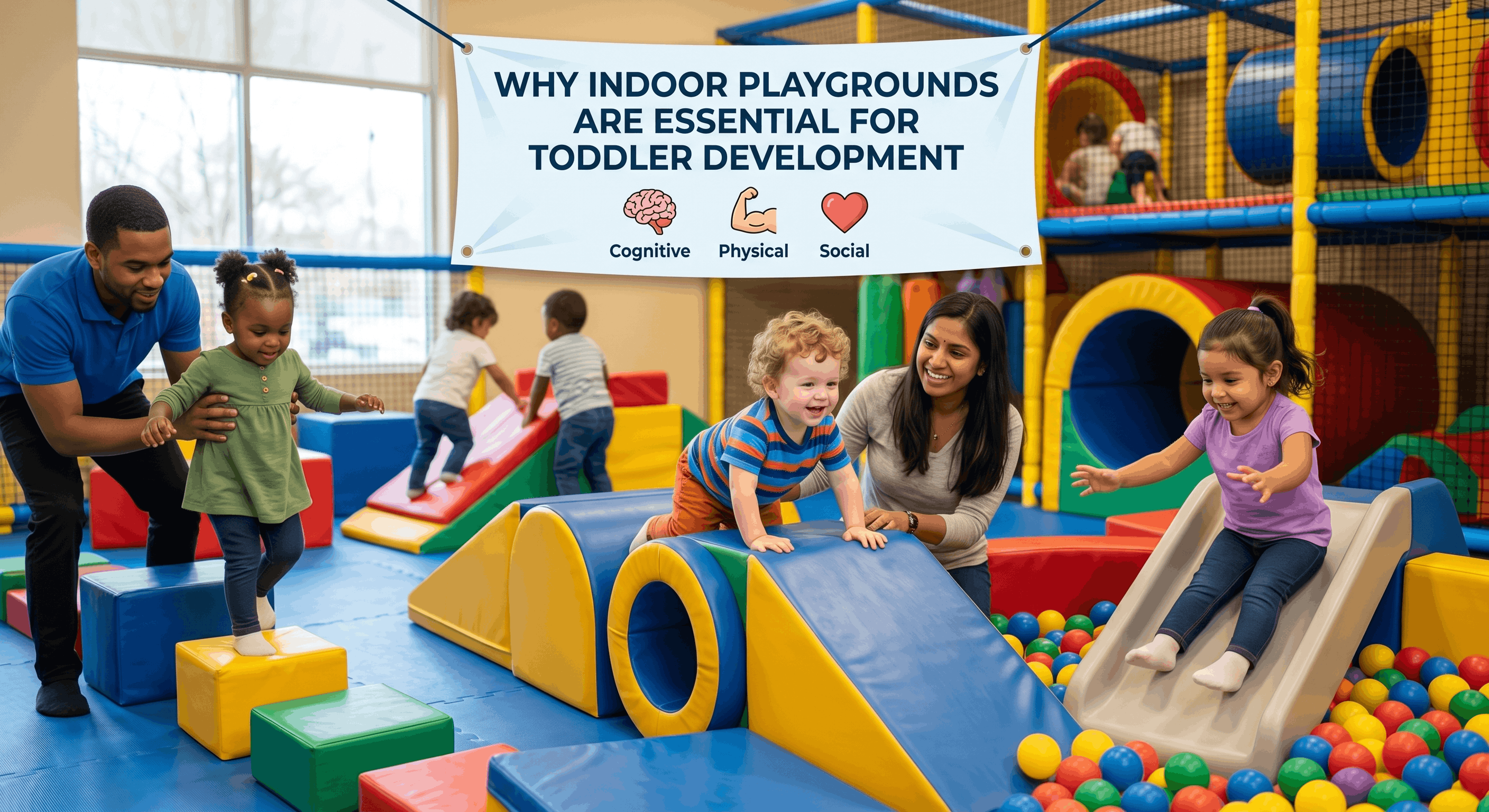
Every parent wants their toddler to grow up healthy, curious and confident. What many parents do not realise is that one of the most powerful tools for early childhood development is not a workbook or an educational app — it is a well-designed indoor playground. Research in child development consistently shows that free, active play is the primary way children between the ages of one and five build the physical, cognitive, social and emotional skills they need for school readiness and lifelong well-being. Indoor playgrounds, particularly those designed with toddlers in mind, create a safe, stimulating environment where all of those developmental milestones come together naturally — and joyfully.
What Is Toddler Development and Why Does Play Matter?
Toddler development refers to the rapid changes in physical ability, brain function, language, social behaviour and emotional regulation that happen between birth and roughly age five. During this window, the brain is forming neural connections faster than at any other point in a person's life. Play — especially unstructured, active, sensory-rich play — is the stimulus that drives this neural growth. Pediatricians and early childhood educators consistently rank play as the single most important activity for healthy development in the toddler years.
Indoor playgrounds support this by offering a controlled, weather-independent space filled with age-appropriate challenges: surfaces to climb, spaces to run, textures to touch, peers to interact with and games that reward curiosity. Every visit to a quality indoor play space is, from a developmental standpoint, a full-body learning session.
How Indoor Playgrounds Support Toddler Development: A Full Picture
|
Area of Development |
What Happens at the Playground |
Long-Term Benefit |
|
Physical (Gross Motor) |
Climbing, jumping, sliding, running on soft surfaces |
Stronger core, better coordination and balance |
|
Physical (Fine Motor) |
Gripping rails, sorting soft blocks, manipulating arcade controls |
Improved hand strength, precision and pencil control |
|
Cognitive |
Navigating multi-level structures, cause-and-effect play |
Problem-solving skills, spatial awareness and memory |
|
Language & Communication |
Playing alongside peers, asking for turns, describing games |
Expanded vocabulary and early conversational skills |
|
Social & Emotional |
Sharing equipment, taking turns, group imaginative play |
Empathy, cooperation and emotional self-regulation |
|
Sensory Processing |
Varied textures, sounds, sights and movement challenges |
Better sensory integration and reduced sensory sensitivity |
Physical Development: Building Strong Bodies Through Active Play
Gross Motor Skills
Gross motor skills involve the large muscle groups that control running, jumping, balancing and climbing. Toddlers develop these skills most effectively through repeated, varied physical challenges — exactly what multi-level climbing structures, slides, tunnels and open run-around spaces provide. Unlike outdoor playgrounds, indoor facilities offer soft-surface flooring and padded equipment that reduce injury risk, allowing toddlers to take on challenges slightly beyond their current ability without parents needing to intervene constantly. That stretch into 'just difficult enough' territory is where the most developmental growth happens.
Fine Motor Skills
Fine motor skills involve the smaller muscles of the hands and fingers. At an indoor playground, toddlers grip climbing handholds, open and close latches on soft play structures, sort foam shapes and, in facilities with age-appropriate arcade areas, press buttons and turn dials. These actions directly build the hand strength and dexterity needed later for holding a pencil, cutting with scissors and performing everyday self-care tasks.
Cognitive Development: Play Is How Toddlers Think
The brain of a toddler is not a smaller version of an adult brain — it is a fundamentally different organ, wired to learn through doing rather than listening. When a toddler navigates a multi-level play structure, they are constantly making decisions: which route to take, how high to step, what to hold on to. This is active problem-solving, and it builds the neural pathways associated with planning, spatial reasoning and executive function.
Cause-and-effect toys and interactive play panels, common in well-equipped indoor playgrounds, introduce early logical thinking: 'If I press this button, that light turns on.' Repeated exposure to these small discoveries builds a cognitive framework for understanding how the world works — the same framework that underpins mathematics, science and reading comprehension in later years.
Language and Communication: Talking Through Play
Language development in toddlers accelerates dramatically in social settings. When a child plays alongside peers, they hear new words, learn to make requests, negotiate ('my turn!'), describe what they are doing and respond to questions. Indoor playgrounds, with their mix of children from different backgrounds and age groups, create a rich language environment that is far more varied than what most children experience at home.
Parents and caregivers also play a role. Narrating what a toddler is doing ('You climbed all the way to the top!') or asking open questions ('Which slide do you want to try next?') turns a play visit into an active language lesson. Indoor playgrounds give families a structured reason to spend quality, distraction-free time together, which is itself one of the strongest predictors of early language ability.
Social and Emotional Development: Learning to Be With Others
Social Skills
Many toddlers spend the majority of their day at home or in small childcare settings with limited peer interaction. Indoor playgrounds change this immediately. Within minutes of arriving, most toddlers are watching other children, imitating their play, attempting to join in, and navigating the basics of shared space. These experiences, simple as they sound, are the foundation of social competence: learning to read others, share resources, take turns and cooperate toward a shared goal.
Emotional Regulation
The playground is also a safe arena for managing big emotions. A toddler who has to wait for the slide, or who falls and decides whether to cry or shake it off and try again, is practising emotional regulation in real time. When parents resist the urge to immediately remove every frustration, children build resilience. Indoor playgrounds are intentionally low-stakes environments, where a tumble onto soft foam teaches more about managing disappointment than any conversation could.
Sensory Processing: Stimulating All Five Senses Safely
Healthy sensory processing — the ability to take in, organise and respond to sensory input from the environment — is foundational to attention, learning and behaviour. Some children are sensory-seeking (they crave intense input: spinning, crashing, loud sounds) and some are sensory-sensitive (easily overwhelmed). A well-designed indoor playground, with varied textures, different noise levels across zones, movement-based equipment and soft lighting areas, can address both ends of that spectrum.
Regular sensory-rich play helps the brain's sensory processing systems mature. Children who get adequate sensory input through active play tend to show better attention spans, calmer behaviour and greater emotional stability — all of which translate directly into school readiness.
Why Indoor Playgrounds Beat Outdoor Parks for Toddler Development in Mississauga
Outdoor parks are valuable, but in Mississauga's climate they are genuinely seasonal. Cold winters, icy equipment, rainy spring days and humid summer afternoons limit how often families can use outdoor play spaces. Indoor playgrounds eliminate the weather variable entirely and typically offer a far richer range of equipment than a standard park can: multi-level structures, dedicated toddler zones with age-appropriate equipment, open gym areas, sensory play panels and, in some facilities, sports arenas and supervised activities. They also offer safe, enclosed spaces that allow toddlers to explore with independence while parents remain close without hovering, which is exactly the level of supported autonomy that developmental research recommends.
What to Look for in an Indoor Playground for Your Toddler
Not all indoor play spaces are equal. When choosing one for a toddler, look for:
• A dedicated toddler zone — separate from older children's play areas, with age-appropriate equipment scaled to smaller bodies
• Soft, padded flooring throughout — especially under climbing structures
• Clean, well-maintained equipment with no sharp edges or broken components
• Adequate adult supervision and clear sight lines so caregivers can watch without being in the way
• A manageable noise level — very loud environments can be overwhelming for sensory-sensitive toddlers
• Variety — a mix of climbing, sliding, crawling, sensory play and open running space covers more developmental ground than a single type of equipment
Kidsports Indoor Playground: Built for Toddler Development in Mississauga
Kidsports Indoor Playground at 4500 Dixie Road, Mississauga offers 18,000 sq. ft. of thoughtfully designed play space for children of all ages, with a dedicated Toddler Zone built specifically for babies and young toddlers. The soft, safe, age-appropriate area lets the smallest visitors crawl, climb and explore independently, while parents stay close in a comfortable, welcoming environment.
Beyond the Toddler Zone, the facility includes multi-level climbing structures for older toddlers and preschoolers, open run-around areas, more than 20 arcade games for developing fine motor and reaction skills, a full indoor KS Soccerplex for active play, and five private party rooms for birthday celebrations.
With over 10 years of experience, a 4.3-star Google rating and thousands of returning Mississauga families, Kidsports has become a trusted part of early childhood routines across the city.
Walk-In Admissions
Infants (under 12 months): Free
Toddlers (1–3 years): $17.99 (unlimited playtime) or $19.99 (play + arcade)
Children (3+ years): $19.99 (unlimited playtime) or $21.99 (play + arcade)
Adults: $4.99 — and one adult is FREE with every playing child
Visit Information
Address: 4500 Dixie Road, Mississauga, ON L4W 1V7
Phone: 905-624-9400
Email: info@kidsportsindoorplayground.com
Hours: Tuesday–Wednesday 3–8 p.m. | Thursday–Friday 12–8 p.m. | Saturday–Sunday 10 a.m.–8 p.m. | Closed Mondays
Plan your visit: kidsportsindoorplayground.com/admission
Frequently Asked Questions
Are indoor playgrounds actually good for toddler development?
Yes. Pediatric research consistently shows that active, unstructured play in stimulating environments supports physical, cognitive, social and emotional development. Indoor playgrounds designed with age-appropriate equipment deliver all of these benefits in a single session.
At what age can a toddler start going to an indoor playground?
Most indoor playgrounds welcome children from birth, though active participation typically begins around 6 to 12 months when babies start crawling. Dedicated toddler zones with soft play equipment and age-appropriate activities are suitable from roughly 12 months onward.
How often should toddlers visit an indoor playground?
There is no strict rule, but developmental experts recommend at least 60 minutes of active play per day for toddlers. A few visits per week to an indoor playground can be a core part of meeting that guideline, especially during winter months when outdoor play is limited.
Is it safe for toddlers to play at indoor playgrounds?
Reputable indoor playgrounds use padded flooring, rounded edges, enclosed structures and age-separated zones to minimise injury risk. Toddler zones are specifically designed for small bodies and lower risk tolerances. As with any play environment, caregiver supervision remains important.
What is the difference between a toddler zone and a general play area?
A toddler zone is designed for children roughly under three years old, with equipment scaled to smaller bodies, softer surfaces and lower maximum heights. General play areas serve older children and may have taller structures, faster slides and more complex equipment that is not appropriate for very young toddlers.
Do indoor playgrounds help with school readiness?
Strongly, yes. The skills built through regular active play — attention span, impulse control, language, cooperation, problem-solving and emotional regulation — are exactly the skills that kindergarten teachers identify as the strongest predictors of a child's successful transition into school.
Final Thoughts
Toddler development is not a checklist to complete — it is a continuous process that unfolds through daily experiences, and play is the most important experience of all. An indoor playground does not just keep children entertained; it gives them the physical challenges, sensory input, social interactions and cognitive stimulation they need to grow into capable, confident kids. Whether it is a quiet Tuesday afternoon in the Toddler Zone or a busy Saturday with the whole family, every visit is a step forward. Come see us at Kidsports Indoor Playground at 4500 Dixie Road, Mississauga — where every child's development begins with fun.