


Is Indoor Playground Good for Child Development? What Parents Need to Know in 2026
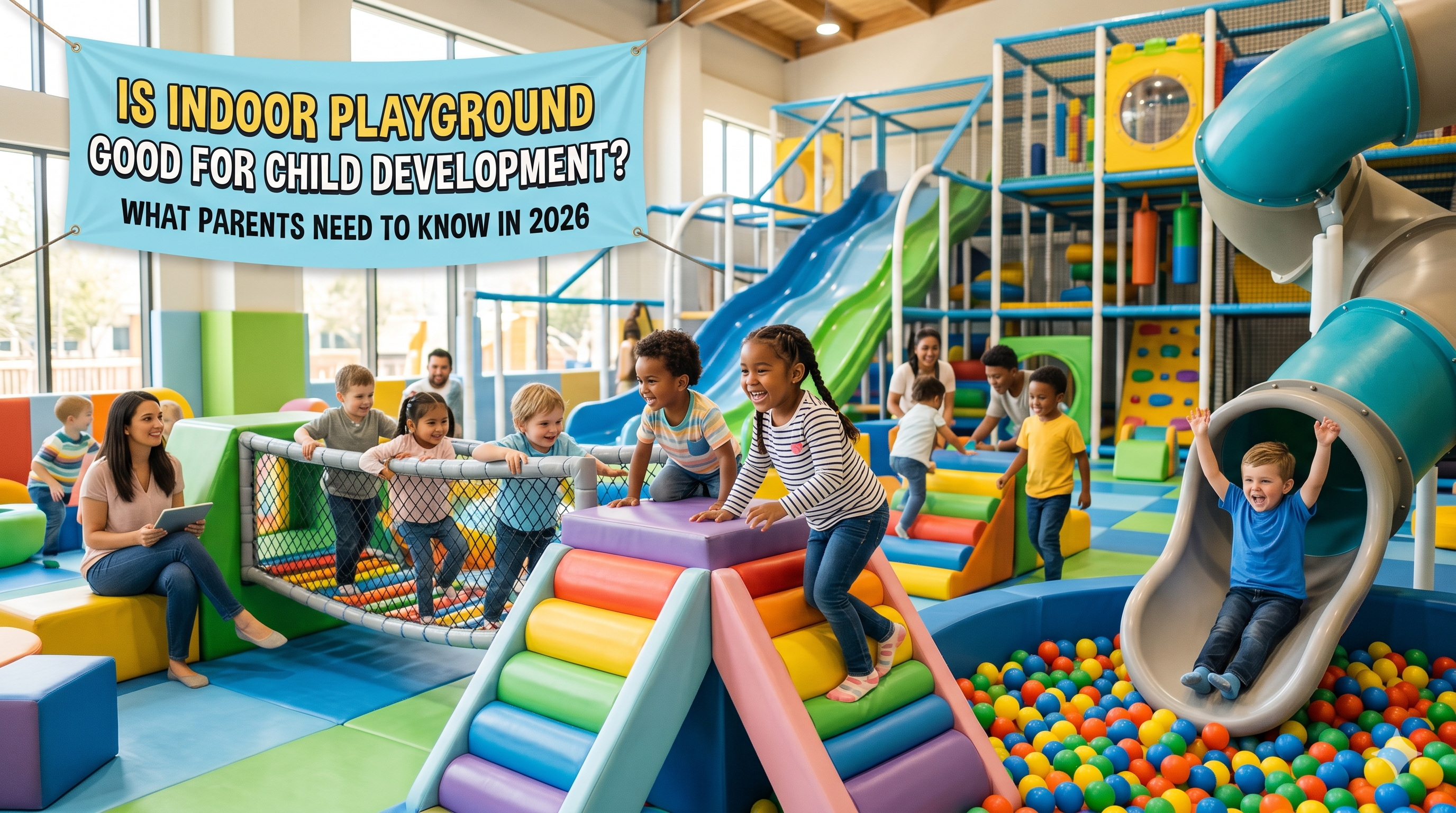
Yes, indoor playgrounds are excellent for child development. Research consistently shows that structured play environments support physical, cognitive, social, and emotional growth in children ages 1-12. Indoor playgrounds specifically offer year-round developmental benefits through safe, supervised activities that promote motor skills, problem-solving, social interaction, and sensory integration—all critical components of healthy childhood development.
When I first started working with families and indoor play facilities back in 2016, parents would ask skeptically: "Isn't this just babysitting?" A decade later, pediatricians, occupational therapists, and child development specialists actively recommend quality indoor playgrounds as essential developmental tools. The transformation in understanding has been remarkable.
The Science Behind Play-Based Development
Child development isn't about worksheets and flashcards—it happens through movement, exploration, and social interaction. The American Academy of Pediatrics' landmark 2018 report emphasized that play is fundamental to healthy brain development, yet modern children play 50% less than their parents' generation did.
Indoor playgrounds fill this critical gap. Unlike passive entertainment, these environments demand active engagement. Every climb strengthens neural pathways. Every social interaction builds emotional intelligence. Every problem solved reinforces cognitive flexibility.
Dr. Stuart Brown, founder of the National Institute for Play, spent decades researching play's impact on development. His findings are unequivocal: children who engage in regular active play show improved executive function, better emotional regulation, and stronger social skills compared to their sedentary peers.
Here's what makes this particularly relevant in 2026: we're now seeing the first generation raised primarily on tablets and smartphones entering adolescence. The developmental gaps are measurable and concerning. Indoor playgrounds offer corrective experiences that screen time simply cannot provide.
Physical Development: More Than Just Exercise
The physical benefits are obvious but often underestimated. Indoor playgrounds don't just tire kids out—they systematically develop motor skills that form the foundation for all future physical competence.
Gross Motor Skills: Climbing structures, slides, and obstacle courses develop large muscle groups and whole-body coordination. A five-year-old navigating a climbing wall isn't just playing—they're integrating visual processing with motor planning, building core strength, and developing spatial awareness. These skills directly transfer to sports performance, injury prevention, and lifelong physical confidence.
Fine Motor Skills: Ball pits require grasping and throwing. Building blocks demand precise hand-eye coordination. Interactive games need finger dexterity. These activities strengthen the small muscles and neural connections essential for writing, self-care tasks, and countless daily activities.
Balance and Coordination: The vestibular system—responsible for balance and spatial orientation—develops through movement. Indoor playground equipment specifically challenges this system through spinning, swinging, climbing, and navigating uneven surfaces. Children who regularly engage these systems show better focus, reduced motion sickness, and improved athletic performance.
Bilateral Coordination: Watch a child on monkey bars. They're not just hanging—they're coordinating left and right sides of their body, crossing the midline (crucial for reading and writing), and building the neural bridges between brain hemispheres. This bilateral integration underlies academic skills that emerge years later.
I've watched countless children arrive at playgrounds with awkward, uncertain movement patterns and leave months later moving with confidence and grace. The transformation isn't magic—it's systematic neural development through repetitive, enjoyable practice.
Cognitive Development: The Thinking Playground
The cognitive benefits surprise parents most. How does climbing develop thinking skills? The connection is direct and profound.
Problem-Solving Skills: Every playground presents challenges. How do I reach the top platform? Which route is fastest? Can I make that jump? Children constantly assess situations, develop strategies, test hypotheses, and adjust based on results. This is scientific thinking in action.
Quality playgrounds increase complexity progressively. A structure that seemed impossible at age three becomes easy at five, naturally driving children toward harder challenges. This growth mindset—understanding that effort creates ability—predicts academic success better than IQ tests.
Spatial Reasoning: Navigating three-dimensional play structures builds mental mapping skills essential for mathematics, engineering, and everyday navigation. Children learn concepts like over, under, through, beside, and between through direct physical experience. These spatial concepts form the foundation for geometry, fractions, and abstract mathematical thinking.
Executive Function: The most critical cognitive skills aren't taught in classrooms—they develop through play. Planning a route through an obstacle course requires working memory. Waiting your turn on the slide demands impulse control. Adapting when another child takes your preferred path needs cognitive flexibility. Together, these executive functions predict life success more reliably than IQ or socioeconomic status.
Recent neuroscience research using fMRI scans shows that active play literally grows the prefrontal cortex—the brain region responsible for planning, decision-making, and self-regulation. This growth happens most dramatically between ages 3-8, precisely when playground use peaks.
Creative Thinking: Open-ended play equipment becomes whatever children imagine. A climbing structure transforms into a castle, spaceship, or mountain. This imaginative play develops creativity, narrative thinking, and the ability to generate novel solutions—skills increasingly valuable as AI handles routine cognitive tasks.
Social-Emotional Development: Learning to Be Human
Perhaps the most valuable developmental domain occurs between children, not within individual minds. Indoor playgrounds create natural social laboratories where children learn the complex dance of human interaction.
Peer Interaction: Playgrounds mix ages, abilities, and backgrounds. A shy four-year-old watches confident five-year-olds, learning through observation. Older children practice leadership and empathy when helping younger ones. These mixed-age interactions—once common in neighborhoods but now rare—provide irreplaceable social learning.
Conflict Resolution: Disagreements happen constantly. Two children want the same toy. Someone cuts in line. A game's rules are disputed. With appropriate adult supervision (not intervention), children learn to negotiate, compromise, and resolve conflicts independently. These skills transfer directly to classroom success, future workplace performance, and personal relationships.
Emotional Regulation: Physical play is inherently frustrating. You fall. You fail. Someone else succeeds where you struggle. Learning to manage disappointment, celebrate others' success, and persist through difficulty builds emotional resilience that determines life outcomes more than academic achievement.
I've watched thousands of parent-child interactions at playgrounds over the years. The parents who resist the urge to solve every problem—who let their child experience manageable frustration and work through it—raise more confident, capable children. Indoor playgrounds provide safe environments for these critical learning experiences.
Communication Skills: Organizing games, explaining rules, asking to join play, and expressing needs all require verbal communication. Children who regularly engage in group play develop vocabulary, conversational skills, and the ability to read social cues significantly faster than those in primarily adult-directed or solitary activities.
Empathy and Perspective-Taking: Seeing another child cry after falling, celebrating a friend's accomplishment, or recognizing when someone feels excluded all develop theory of mind—understanding that others have different thoughts, feelings, and perspectives. This fundamental social cognition emerges and strengthens through peer interaction.
Sensory Integration: The Hidden Developmental Benefit
This is where my expertise really comes into play after a decade of consulting with occupational therapists and pediatric specialists. Sensory integration—how the brain processes and responds to sensory information—underlies all other development, yet most parents barely understand it.
Proprioceptive Input: This sense tells us where our body is in space. Climbing, jumping, and hanging all provide heavy proprioceptive input that helps children regulate their arousal levels and develop body awareness. Many children seek this input instinctively—they're not "hyperactive," they're addressing genuine neurological needs.
Vestibular Stimulation: The inner ear's balance system develops through movement, especially rotation and position changes. Slides, swings, and spinning equipment provide controlled vestibular input crucial for attention, balance, and coordination. Children with vestibular processing difficulties often show dramatic improvements with regular playground use.
Tactile Experiences: Ball pits, textured climbing walls, and varied surfaces provide tactile input that helps children process touch sensations. This develops body boundaries, reduces tactile defensiveness (the reason some kids hate tags in clothes), and builds the sensory discrimination needed for fine motor skills.
Quality indoor playgrounds intentionally incorporate sensory-rich experiences. The best facilities consult occupational therapists during design to ensure equipment addresses diverse sensory needs. This is why some children—particularly those with ADHD, autism spectrum disorders, or sensory processing challenges—show remarkable behavioral improvements with regular playground access.
Age-Specific Developmental Benefits
Development isn't uniform. What a toddler needs differs dramatically from what benefits a school-age child. Well-designed indoor playgrounds accommodate these varying needs.
Toddlers (1-3 years): Focus on gross motor milestones—walking, climbing, jumping. Soft play areas let them practice movement without injury risk. Simple cause-and-effect toys develop cognitive understanding. Parallel play (playing alongside but not with peers) builds social awareness.
Preschoolers (3-5 years): More complex movement challenges develop coordination and confidence. Imaginative play areas support creativity and language development. Beginning cooperative play teaches sharing and basic social rules. Simple problem-solving equipment builds cognitive skills.
School-Age Children (6-12 years): Advanced climbing challenges, competitive games, and complex obstacle courses support this age group's need for mastery and achievement. Team activities develop cooperation and leadership. Strategic games build planning skills. Physical challenges provide healthy outlets for energy and stress.
The beauty of quality indoor playgrounds is simultaneous accommodation of all ages. Older siblings can play while parents supervise toddlers. This mixed-age environment mirrors historical human development patterns that modern age-segregated schooling has disrupted.
Indoor vs. Outdoor Play: Different but Complementary
I'm often asked whether indoor playgrounds replace outdoor play. Absolutely not—they complement it. Each environment offers unique developmental benefits.
Outdoor play provides natural sensory experiences, vitamin D exposure, and connection with nature—all valuable. Weather variability, however, limits consistency. Canadian winters, rainy springs, and extreme summer heat disrupt regular outdoor play patterns.
Indoor playgrounds ensure year-round consistency crucial for developmental progress. They offer controlled sensory experiences particularly valuable for children with processing difficulties. Equipment maintenance and safety standards often exceed outdoor playground capabilities.
The ideal developmental diet includes both. Indoor playgrounds provide reliable access to active play regardless of weather while outdoor environments offer complementary benefits. Neither replaces the other—together they create optimal developmental support.
What Research Shows: The Evidence Base
After working in this field for ten years, I've seen the research base explode. What was intuitive understanding in 2016 is now backed by rigorous scientific evidence.
Studies published in Pediatrics, Developmental Psychology, and the Journal of Physical Activity and Health consistently demonstrate that children with regular access to quality play environments show:
- 35% better gross motor skill development
- Significantly improved executive function scores
- Better emotional regulation and reduced behavioral problems
- Enhanced social competence and peer relationships
- Reduced obesity risk and improved cardiovascular fitness
- Better academic performance, particularly in mathematics and spatial reasoning
The longitudinal studies are particularly compelling. Children who engage in regular active play during early childhood show better outcomes decades later—higher educational attainment, better employment outcomes, improved health markers, and stronger social networks.
This isn't correlation masquerading as causation. Controlled studies manipulating play access demonstrate causal relationships. Play doesn't just correlate with development—it causes it.
Red Flags: Not All Indoor Playgrounds Are Equal
My decade of experience has taught me to spot facilities that maximize developmental benefits versus those merely providing childcare. Parents should evaluate carefully.
Quality Indicators:
- Age-appropriate zones with suitable challenge levels
- Regular equipment maintenance and cleaning protocols
- Trained staff who understand child development
- Proper supervision ratios
- Variety of equipment addressing different developmental domains
- Clear safety standards and emergency procedures
- Inclusive design accommodating children with different abilities
Warning Signs:
- Overcrowded spaces with inadequate supervision
- Poorly maintained or broken equipment
- Staff more focused on phones than children
- One-size-fits-all equipment unsuitable for developmental range
- Lack of clear safety protocols
- Excessive screen-based entertainment
- No accommodation for children with special needs
The difference matters enormously. A quality facility amplifies developmental benefits. A poor one risks injury while providing minimal developmental value.
Addressing Common Parental Concerns
Over the years, I've heard every concern imaginable. Let me address the most common with evidence-based responses.
"Aren't they just running wild?" Unstructured doesn't mean chaotic. Child-directed play within safe boundaries is precisely what develops self-regulation, creativity, and autonomy. Adult-directed activities have their place, but children need opportunities to direct their own play.
"My child seems overstimulated afterward." This is normal and actually beneficial. The arousal from play helps regulate sleep cycles. The temporary overstimulation followed by calming (usually within 30-60 minutes) exercises the nervous system's regulation capabilities.
"Won't they get sick from other children?" Immune system development requires pathogen exposure. While reasonable hygiene standards matter, excessive cleanliness may harm long-term immune function. Children who attend playgrounds regularly actually develop stronger immune systems.
"They're not learning anything educational." This fundamentally misunderstands how children learn. The motor planning required to navigate an obstacle course builds neural connections underlying mathematical reasoning. The social negotiation in group play develops communication skills essential for academic collaboration. Play is education.
"Isn't outdoor play better?" As discussed, both offer unique benefits. Indoor playgrounds provide consistent access regardless of weather—crucial for establishing routines and ensuring adequate active play year-round.
Special Populations: Indoor Playgrounds for All Children
Some of the most remarkable transformations I've witnessed involve children with developmental differences. Quality indoor playgrounds benefit all children, but they're often life-changing for those with special needs.
Children with Autism Spectrum Disorders: Controlled sensory environments help manage sensory processing challenges. Structured social opportunities with clear rules support social skill development. Physical activities provide sensory input that reduces anxiety and improves regulation.
Children with ADHD: Physical activity is medicine for ADHD. Indoor playgrounds provide high-intensity movement that improves focus, reduces impulsivity, and enhances attention. The proprioceptive and vestibular input specifically addresses neurological needs.
Children with Developmental Delays: Playgrounds offer practice opportunities without the pressure of structured therapy. Natural motivation to play drives repetition that builds skills. Observational learning from typically developing peers accelerates progress.
Children with Physical Disabilities: Inclusive playgrounds with adaptive equipment ensure all children can participate. The social inclusion and physical challenges support both development and self-esteem.
The key is finding facilities committed to inclusion, with staff trained to support diverse needs and equipment designed for universal access.
Maximizing Developmental Benefits: A Parent's Guide
Simply attending isn't enough—how you support your child's play matters enormously.
Follow Your Child's Lead: Resist directing play. Observe what attracts their attention and support their exploration. The developmental magic happens when children direct their own activities.
Provide Encouragement, Not Pressure: "You're trying really hard" beats "You can do it!" Emphasize effort over outcome. Accept that falling, failing, and frustration are valuable learning experiences.
Allow Appropriate Risk: This is where a decade of experience tells me most parents struggle. Your anxiety about your child falling is understandable but often counterproductive. Manageable risk—climbing slightly beyond current comfort, attempting challenging equipment, engaging in rough-and-tumble play—is essential for development.
Minimize Screen Interruptions: Your phone use models behavior. Being present—watching your child's accomplishments, being available for comfort after falls—supports emotional development. Documenting every moment on your phone doesn't.
Encourage Social Interaction: Support your child in joining group play, but don't force it. Model polite ways to ask to join activities. Help them navigate conflicts without immediately solving problems for them.
Maintain Consistent Routines: Regular playground visits (ideally 2-3 times weekly) provide developmental consistency. One monthly visit offers minimal benefit compared to regular engagement.
Choose Quality Facilities: Not all playgrounds are equal. Prioritize well-maintained equipment, appropriate supervision, age-appropriate challenges, and inclusive design over proximity or price.
The Long-Term Impact: Beyond Childhood
The developmental benefits don't disappear at adolescence—they compound throughout life. Children who engage in regular active play during early childhood show measurably better outcomes across virtually every domain researchers examine.
Physical Health: Early motor skill development predicts lifelong physical activity levels. Children who develop movement competence and confidence typically maintain active lifestyles, with all associated health benefits—reduced obesity, better cardiovascular health, stronger bones, improved immune function.
Mental Health: The emotional regulation, stress management, and social skills developed through play protect against anxiety and depression. The problem-solving skills and resilience built through navigating playground challenges transfer to managing life's difficulties.
Academic and Career Success: Executive function developed through play predicts academic achievement more reliably than early academic instruction. The creativity, collaboration, and communication skills practiced at playgrounds are precisely what succeeds in modern workplaces.
Social Relationships: The social competence developed through peer play forms the foundation for all future relationships—friendships, romantic partnerships, workplace relationships, parenting. Children who learn to navigate social complexity through play generally develop stronger, more satisfying relationships throughout life.
The research is clear: the hours spent at playgrounds during childhood are among the most valuable investments in long-term wellbeing, success, and happiness.
Making the Choice: Is It Worth It?
After ten years working with families and indoor play facilities, analyzing research, consulting with developmental specialists, and watching countless children grow, my answer is unequivocal: yes, quality indoor playgrounds are exceptionally good for child development.
They're not just good—they're essential in modern contexts where outdoor play opportunities have diminished, screen time has exploded, and structured activities have replaced free play. Indoor playgrounds provide developmental experiences that children desperately need but increasingly lack.
The investment—whether time, money, or both—returns dividends throughout life. The motor skills, cognitive abilities, social competence, and emotional regulation developed through play form the foundation for everything that follows.
Your child won't remember specific playground visits. But the neural connections formed, skills developed, and confidence built will shape their entire life trajectory. That's not hyperbole—it's what the developmental science clearly demonstrates.
So yes, indoor playgrounds are good for child development. Exceptionally good. Perhaps better than almost anything else you'll invest in during your child's early years.
Frequently Asked Questions
Q: At what age should children start using indoor playgrounds?
Most indoor playgrounds accommodate children as young as 12-18 months with dedicated toddler areas featuring soft play equipment and age-appropriate activities. However, developmental readiness varies individually. Your child is ready when they can navigate soft play structures with minimal support, show interest in climbing and exploring, and can follow basic safety directions. Many facilities offer specific toddler times with reduced capacity for younger children's comfort. The most critical developmental period for indoor playground use is ages 2-8, when motor skill development and social learning progress most rapidly.
Q: How often should children visit indoor playgrounds for optimal development?
Research suggests 2-3 visits weekly provides optimal developmental benefits, with each session lasting 60-90 minutes. This frequency ensures skill consolidation while avoiding overuse injuries. Consistency matters more than duration—regular weekly visits outperform occasional marathon sessions. For children with sensory processing needs or motor delays, occupational therapists often recommend daily movement activities, making indoor playgrounds valuable components of therapeutic routines. However, even once-weekly visits provide meaningful benefits compared to no structured active play.
Q: Can indoor playground time replace organized sports or physical education?
Indoor playgrounds and organized sports serve different but complementary developmental purposes. Playgrounds excel at developing fundamental motor skills, creative play, and self-directed exploration. Organized sports teach rule-following, structured teamwork, and sport-specific skills. Neither replaces the other. For children under 6, indoor playgrounds often provide superior developmental value because young children need movement variety and exploration more than sport-specific training. For school-age children, the combination of both creates optimal physical development—playgrounds for broad motor competence, sports for specialized skill development and competitive experiences.
Q: Are indoor playgrounds safe? What about injuries?
Quality indoor playgrounds with proper safety standards, maintenance protocols, and supervision show lower injury rates than outdoor playgrounds or organized sports. Most injuries are minor (bruises, small scrapes) and actually contribute to development—children learn physical limits and risk assessment through minor consequences. Serious injuries are rare in well-maintained facilities with appropriate supervision ratios. Parents should verify that facilities conduct regular equipment inspections, maintain current safety certifications, employ trained staff, and have clear emergency protocols. Age-appropriate equipment zones significantly reduce injury risk by ensuring children encounter suitable challenges for their developmental level.
Q: Do indoor playgrounds benefit children with special needs?
Yes, significantly. Children with autism spectrum disorders often show dramatic improvements in sensory regulation, social skills, and anxiety reduction with regular playground access. The controlled sensory environment helps manage overstimulation while providing necessary proprioceptive and vestibular input. Children with ADHD benefit enormously from the intense physical activity, which functions similarly to medication in improving focus and reducing impulsivity. Those with developmental delays gain from observational learning and motivation-driven practice. However, parents should seek inclusive facilities with trained staff, adaptive equipment, and sensory-friendly programming. Many progressive playgrounds now offer sensory-friendly hours with reduced noise and crowds specifically for children with processing sensitivities.
Q: What's the difference between cheap entertainment centers and quality developmental playgrounds?
Quality developmental playgrounds prioritize age-appropriate challenge, varied equipment addressing different developmental domains, trained staff who understand child development, and design informed by pediatric occupational therapists. They balance free play with structured activities and maintain rigorous safety and cleanliness standards. Entertainment centers often emphasize passive activities (arcade games, screens), overcrowd facilities, employ untrained supervisors, and use one-size-fits-all equipment unsuitable for developmental ranges. The developmental benefits differ dramatically. Quality indicators include: multiple activity zones for different ages, equipment promoting diverse movement patterns, staff actively engaging children, clear educational philosophy, and partnerships with developmental specialists.
Q: Can screen-based activities in playgrounds provide developmental benefits?
Limited, thoughtfully integrated technology can complement physical play, but screens should never dominate playground experiences. Interactive floor projections encouraging physical movement, augmented reality scavenger hunts promoting exploration, or cooperative digital games requiring teamwork can enhance engagement. However, passive screen time (videos, individual tablet use) provides minimal developmental value and contradicts playgrounds' fundamental purpose—active physical and social engagement. The research is clear: developmental benefits come from movement, physical challenges, and face-to-face social interaction. Quality playgrounds use technology sparingly and only when it augments rather than replaces active play. Parents should be cautious of facilities where screens are primary entertainment rather than occasional supplements.
Q: How do I know if my child is getting developmental value versus just burning energy?
Observe specific skill progressions over time: improved climbing ability, better balance, increased social confidence, enhanced problem-solving when encountering obstacles, and greater emotional regulation. Developmental growth manifests as your child attempting progressively harder challenges, engaging more confidently with peers, demonstrating better body control, and showing increased independence in navigating the environment. Simple energy expenditure happens anywhere; developmental progression requires appropriate challenge levels that advance as skills improve. If your child repeats identical activities without progression, the environment may not provide sufficient challenge. Quality facilities design equipment encouraging natural skill advancement and staff notice when children need new challenges.
Q: Should parents actively play with their children or supervise from the sidelines?
This depends on the child's age and temperament. Toddlers (1-3) benefit from active parental participation—you model climbing, provide security for new challenges, and facilitate early social interactions. Preschoolers (3-5) need nearby supervision with occasional participation when they invite you into play. School-age children (6+) develop best when parents supervise attentively but allow independent play, intervening only for safety or when children request help. The key is responsive presence—being emotionally available and physically close enough to support when needed while encouraging independence. Helicopter parenting that prevents any risk-taking or directs all activities undermines developmental benefits. Your role evolves from playmate to safety observer to emotional support base as children mature.
Q: Are there any developmental downsides to indoor playground use?
When used appropriately, downsides are minimal. Potential concerns include: over-reliance on structured environments at the expense of unstructured outdoor exploration, reduced nature exposure if playgrounds completely replace outdoor time, and possible overstimulation in children with sensory sensitivities (mitigated by choosing appropriate facilities and timing). Some child development specialists worry about excessive safety features preventing valuable risk-taking, though quality playgrounds balance safety with appropriate challenge. The solution is viewing indoor playgrounds as important developmental tools within a broader activity portfolio including outdoor play, quiet activities, creative pursuits, and family time—not as exclusive entertainment or childcare solutions.
Looking for a quality indoor playground that prioritizes child development? Visit KidSports Indoor Playground in Mississauga—where play meets purpose and every child thrives. Designed with developmental expertise and backed by ten years of experience supporting growing children.